

 Wood Pressed Oils
 Coconut Oil
 Natural Honey
 Forest Honey
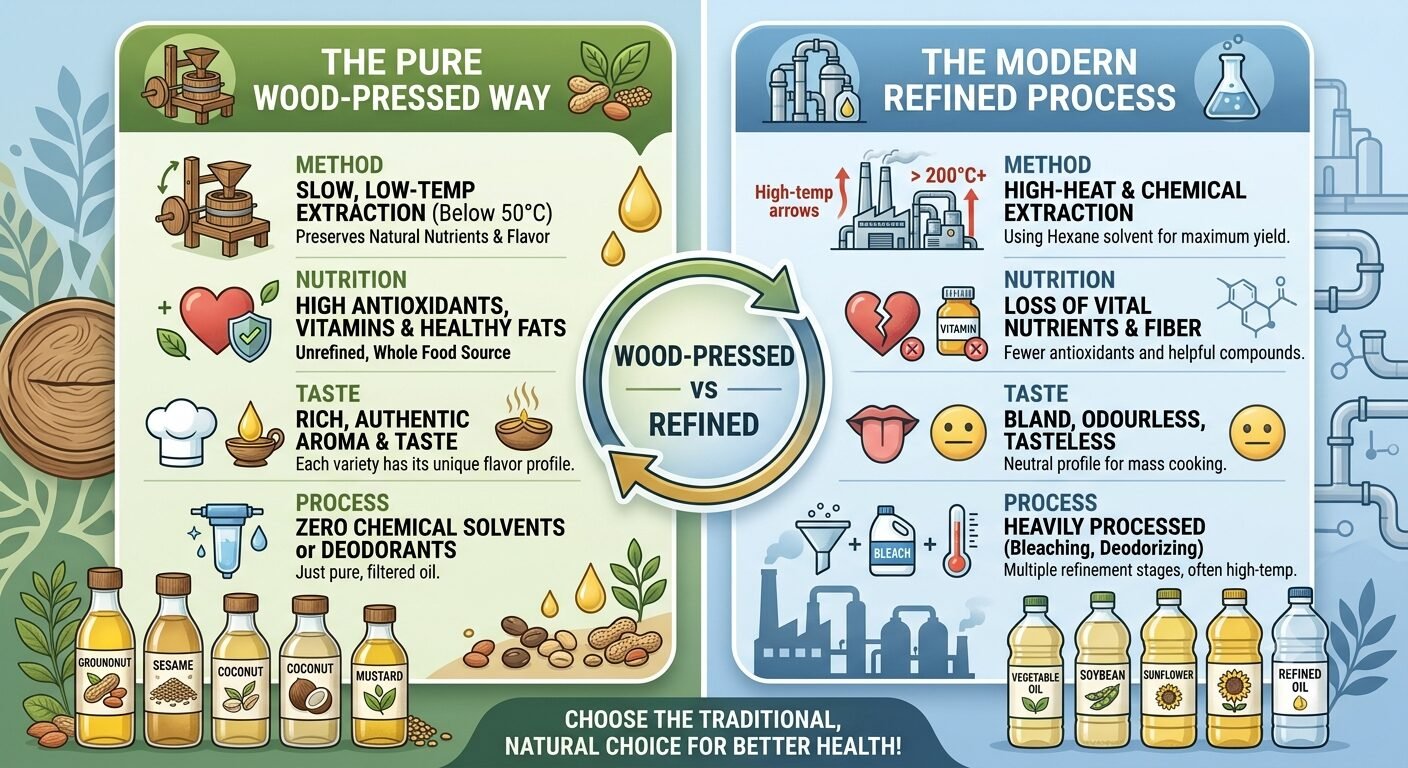
In the quest for a healthier lifestyle, we often obsess over macronutrients like protein and carbs, but we frequently overlook the most fundamental component of our daily cooking: the oil.
The debate between traditional Wood Pressed Oil and modern Refined Oil isn’t just about taste—it is about the integrity of the food you put into your body. Let’s break down the differences to see which one deserves a permanent spot in your pantry.
The Core Difference: How It’s Made
1. Refined Oil: The Industrial Approach
Refined oil is a product of modern industrial efficiency. The goal is to produce large quantities of oil that look, smell, and taste consistent, with an extremely long shelf life.
- The Process: Seeds are crushed under high pressure, generating extreme heat. Chemical solvents (like Hexane) are often used to extract every last drop of oil.
- The “Refining”: After extraction, the oil is bleached, deodorized, and treated with synthetic preservatives to make it clear, scentless, and uniform.
2. Wood Pressed Oil: The Traditional Approach
Wood pressing—often called Kachi Ghani or Chekku—is a mechanical, low-temperature extraction process.
- The Process: Seeds are pressed in a wooden mortar using a wooden pestle. The wood absorbs the friction, keeping the temperature low.
- No Chemicals: No chemicals, solvents, or high-heat refining agents are used. What you get is the raw, pure essence of the seed in its most natural form.
Quick Comparison Table
| Feature | Wood Pressed Oil | Refined Oil |
| Extraction | Low-temperature mechanical press | High-heat + Chemical solvents |
| Nutrients | Retains vitamins, antioxidants & minerals | Lost during high-heat processing |
| Aroma/Taste | Natural, rich, and nutty | Neutral (deodorized) |
| Additives | None (100% natural) | Often includes synthetic preservatives |
| Shelf Life | Shorter (as it is natural) | Longer (due to processing/additives) |
Why Wood Pressed Oil is the Healthier Choice
The “health” of an oil isn’t just about fat content; it’s about what the oil does for your body. Here is why Wood Pressed wins:
A. Retention of Vital Nutrients
Because wood pressing avoids high heat, the oil retains Vitamin E, polyphenols, and essential fatty acids. These antioxidants are natural warriors against oxidative stress and inflammation—the two primary drivers of modern chronic diseases.
B. No Toxic Residues
Refining requires the use of chemical solvents to squeeze out the oil. While manufacturers claim these are removed, trace amounts of chemical residues can remain. Wood pressed oil is entirely chemical-free, offering you pure energy without the toxic baggage.
C. Superior Stability and Digestion
Refined oils are often highly processed, which can change the molecular structure of the fats, making them harder for the body to break down. Wood pressed oils are closer to their natural state, making them generally easier to digest and better for your gut health.
The Verdict: Which One Should You Choose?
If your priority is long-term health, cellular wellness, and authentic flavor, the choice is clear: Wood Pressed Oil is the superior option.
Refined oils are designed for shelf-stability and mass manufacturing, not for nutritional density. By choosing wood-pressed, you are opting for an oil that is rich in nutrients and free from industrial chemicals.
How to transition safely:
- Start with one: Replace your primary frying or tempering oil with a wood-pressed version.
- Understand the profile: Because it is raw and natural, the color and viscosity may vary slightly between batches—this is a sign of high-quality, authentic production.
- Store correctly: Since wood-pressed oils lack synthetic preservatives, keep them in a cool, dark place to maintain their freshness.
Your kitchen is the foundation of your family’s health. By choosing traditional methods over industrial shortcuts, you are taking a significant step toward a cleaner, more vibrant life.
Ready to experience the difference? Explore our range of pure, wood-pressed oils and taste the difference that traditional processing makes.